August, 2026
Rasterization
This article assumes familiarity with rendering concepts such as texels, samples, coverage, and shading. It was informed by my work functionally modelling AMD's rasterization stage.
Rasterization is the algorithm responsible for converting a 2D triangle into a set of texel or sample coordinates for shading. The Direct3D and Vulkan graphics APIs both specify formal requirements for rasterization to ensure shaded texels are consistent between vendors. This article explains the requirements in the specifications, and builds a conformant scanline rasterizer for triangles.
The Specification
Assume framebuffer coordinates have their origin at the upper-left corner of the upper-left texel, with
Point Sampling
Vulkan defines coverage by point sampling:
Fragments are produced for any fragment area groups of pixels for which any sample points lie inside of this polygon. Coverage bits that correspond to sample points that satisfy the point sampling criteria are 1, other coverage bits are 0.
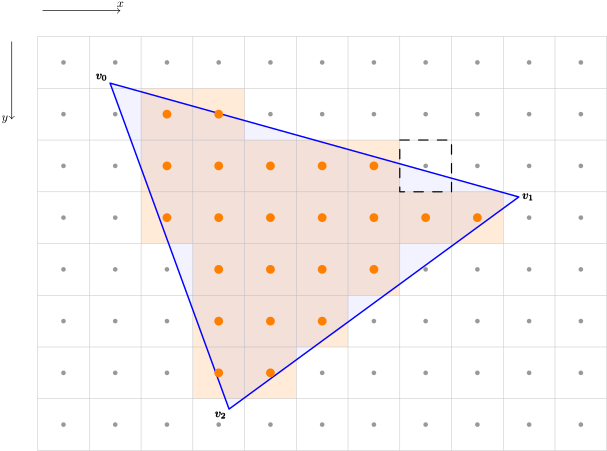
Coverage is a predicate on sample positions, not a measure of area. The dashed texel is substantially overlapped but produces nothing.
A primitive overlapping most of a texel produces nothing if no sample lies inside it, and a sub-texel sliver produces a fragment if one does.
The Fill Rule
A sample lying exactly on an edge is a boundary case. It occurs suprisingly often, whenver an edge is axis-aligned on the sample grid.
The Vulkan specification is typically generic, stating
if two polygons lie on either side of a common edge (with identical endpoints) on which a sample point lies, then exactly one of the polygons must result in a covered sample for that fragment during rasterization.
Direct3D 11.3 is more specific, explicitly requiring the top-left rule:
If an edge is exactly horizontal, and it is above the other edges of the triangle in pixel space, then it is a "top" edge. If an edge is not exactly horizontal, and it is on the left side of the triangle in pixel space, then it is a "left" edge. [...] If a sample location falls exactly on the edge of a triangle, the sample is inside the triangle if the edge is a "top" edge or a "left" edge.
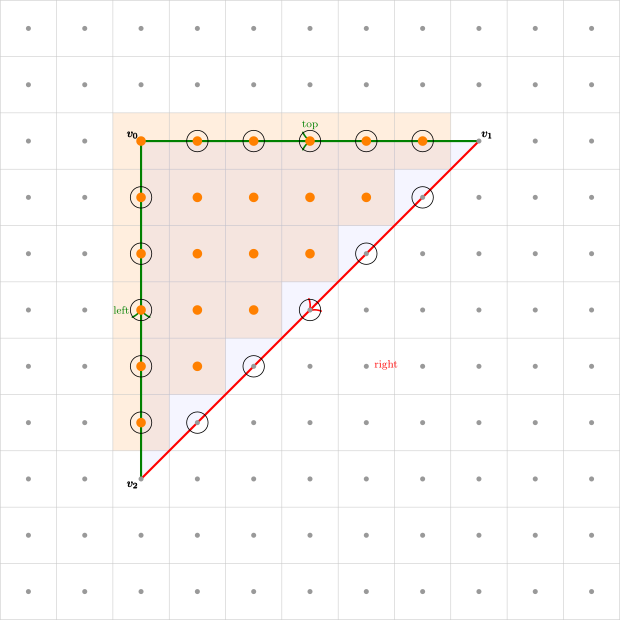
A triangle positioned so that samples fall exactly on all three edges. Circled samples are those the rule decides.
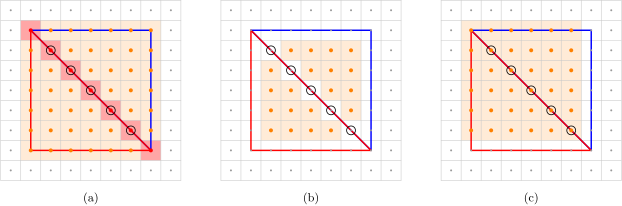
A quad triangulated along a diagonal passing through samples. (a) every edge inclusive, and the diagonal is drawn twice. (b) every edge exclusive, and it is dropped. (c) the top-left rule, covering each sample once. The rule also decides the quad's outer boundary: its top and left edges are covered, its bottom and right are not.
Fixed Point Coordinates
Section §3.4.1 of the D3D11.3 specification requires that after clipping and the perspective divide, vertex subPixelPrecisionBits, at least
Section §3.2.4 provides a formal definition of fixed point representations and conversions. As a refresh, fixed point represents a decimal value as an integer with an implicit decimal point at a fixed location, written
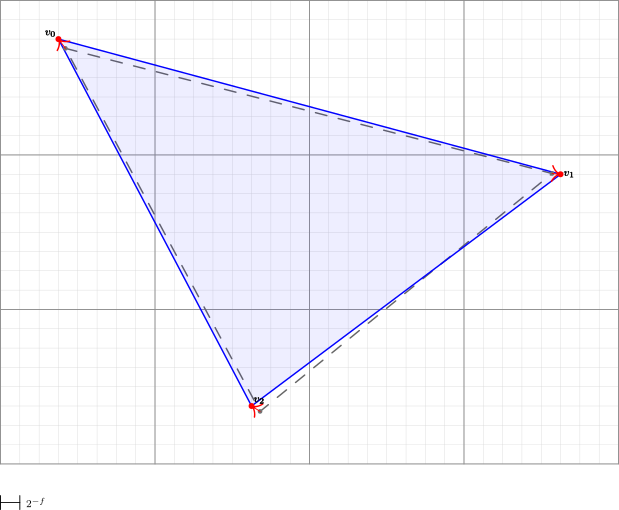
Conversion to fixed point, drawn with
After conversion to fixed point, the rasterizer's stages should ensure no rounding occurs. The fixed point triangle defines the exact coverage.
Edge case: a primitive of zero area is supposed to produce no fragments. Area is evaluated after conversion, so a primitive with small nonzero area which collapses in
Operations on Fixed Point Values
The format of a fixed point value propagates as
In plain language: addition and subtraction don't require more bits in fixed point but multiplication needs double the bits.
Viewport Size, Clipping and Guard Bands
Clipping ensure a primitive does not extend outside a certain boundary. Conceptually, this is usually thought of as the edges of the screen. However, because clipping is an expensive operation which amplifies the number of primitives, clipping actually occurs against a guard band which can extend well beyond the screen coordinates. A primitive that leaves the viewport but is inside the guard band has out of bounds pixels discarded (or not rasterized at all). Only a primitive leaving the guard band is clipped geometrically.
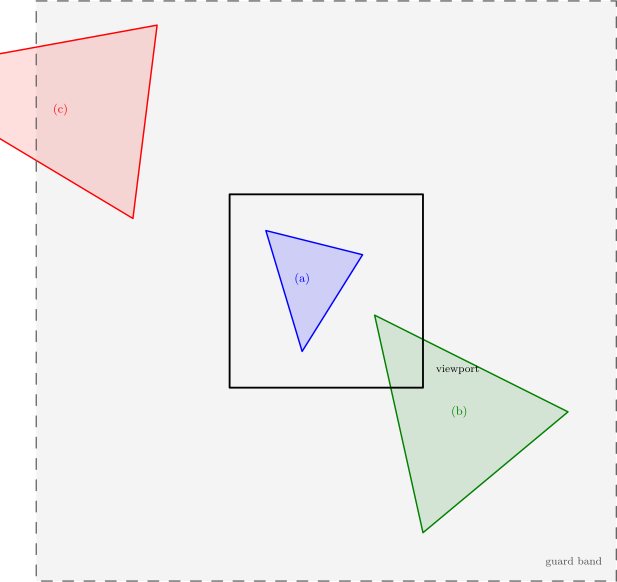
(a) inside the viewport. (b) outside the viewport but inside the guard band, rasterized whole with the walker clamped. (c) outside the guard band, and the only case that is clipped.
An Algorithm
Checking Coverage with Barycentrics
Barycentric coordinates are already needed to interpolate attributes across a triangle. They can also be used to test whether a sample point is covered by a triangle.
Define the edge function
which is twice the signed area of
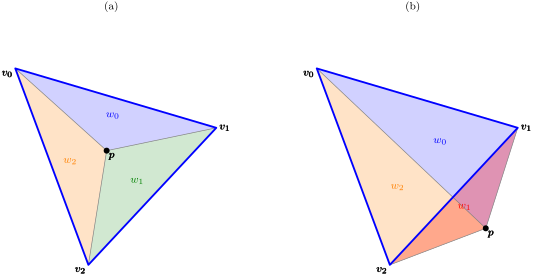
(a) a sample inside the triangle, where no weight is negative. (b) a sample outside it: the sub-triangle opposite the crossed edge reverses orientation, so
These quantities are proportional to the barycentric coordinates of
Thus, if the triangle is counterclockwise,
are its barycentric coordinates. A point is inside the triangle (including edges) when
For a clockwise triangle, all signs are reversed, so the equivalent test is
The Top-Left Rule
We need to avoid samples which lie exactly on an edge being incorrectly included or excluded.
For a directed edge
We can encode this constraint directly into our barycentric test by biasing the weights according to the edge conditions. A weight is a product of coordinate differences, so it carries
bias(a, b):                              # once per edge
    top  = y_a == y_b and x_b > x_a
    left = y_b < y_a
    return 0 if (top or left) else -ulp  # ulp = 2^-2f

covered(p):                              # once per sample, assumes CCW
    return D(v0, v1, p) + bias(v0, v1) >= 0
       and D(v1, v2, p) + bias(v1, v2) >= 0
       and D(v2, v0, p) + bias(v2, v0) >= 0
Each weight is paired with the bias of the edge it is measured against, and the three biases are fixed once the primitive is set up.
Candidate Texel Walker
Sample positions are the subtexel positions that determine whether a texel is covered.

Vulkan standard sample locations, relative to the upper-left corner of a texel.
A walker bounded against sample positions would have to account for these subtexel geometries. Bounding against whole texels is conservative and allows any sampling rate, even variable rates.
Divide the framebuffer into horizontal rows (or scan lines) of texels. Row
Once we have start and end we can test each sample.
for y in rows spanned by the primitive:
    for x in [floor(start[y]), floor(end[y])]:
        for s in sample_positions:
            p = (x + s.x, y + s.y)
            if covered(p): emit(p)
To find start and end we start by reducing the number of cases by sorting the vertices so that
- The long edge
- The short edges
Note that the edge are defined so they go from top to bottom. Depending on the winding order we can clasify the long edge as either a left or right edge.
- If the winding order is clockwise: the long edge is a left edge.
- If the winding order is counter-clockwise: the long edge is a right edge.
As a small trick, we can compute the winding order cheaply from the parity of the number of swaps we performed when sorting. We flip the pre-sort winding order if the parity is odd.
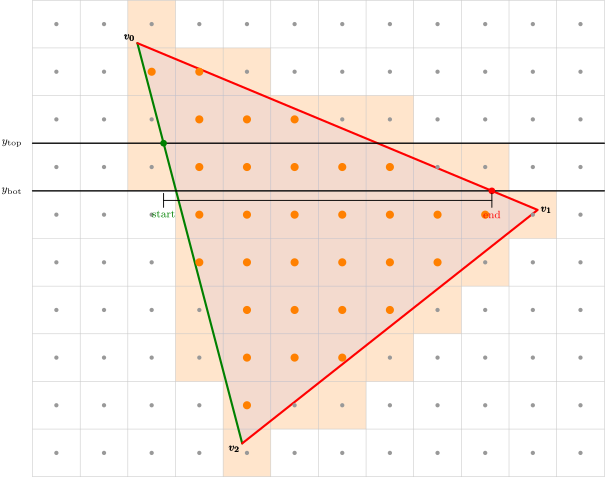
One pair per band. Here the long edge is a left edge, so it supplies every
Interpolating an Edge
Take one edge, running from
Two of those
We accumulate
We need to account for the rounding introduced by the division when calculating step. Held to
Reading the Correct End of a Band
Within a band the edge is a straight line, so its extreme
A left edge contributes to
A right edge contributes to
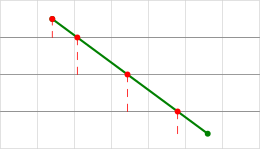
A left edge with
The Band Containing the Shared Vertex
The short edges meet at

The band holding
Putting It Together
Here is psuedocode for the walker logic.
# precondition: y_a <= y_b
walk(edge a -> b, side):
    if y_a == y_b:
        contribute min or max of x_a, x_b to its single band
        return

    step = (x_b - x_a) / (y_b - y_a)
    x    = x_a + (ceil(y_a) - y_a) * step

    top = x_a
    for j in bands spanned by the edge:
        bot = x_b if j is the last band else widen(x)

        if edge is left: contribute (step >= 0 ? top : bot) to start
        else:            contribute (step >= 0 ? bot : top) to end

        top = bot
        x  += step
The algorithm presented in this article is one solution consistent with the Vulkan and D3D11 rasterization specifications. While it is a performant serial algorithm it is not how GPU hardware works.
Further Reading
- Pineda, A Parallel Algorithm for Polygon Rasterization.
- McCormack and McNamara, Tiled Polygon Traversal Using Half-Plane Edge Functions.